Samia Halaby
Ensemble
Samia Halaby is a pioneering Palestinian artist, scholar, and activist whose six-decade career has redefined the scope and politics of abstract painting.
Born in Jerusalem and based in New York City since the 1970s, Halaby is widely recognized as one of the most important figures in contemporary Arab art.
Rooted in a lifelong investigation of abstraction, her practice is grounded in continuous experimentation, drawing from sources as varied as Islamic architecture, Russian Constructivism and Abstract Expressionism. Refusing the binary of East and West or nationalist and universalist discourses, Halaby’s abstract compositions are rooted in a deep engagement with movement, rhythm, and visual perception, often inspired by natural forms, urban landscapes, and the geometry of traditional Islamic art.
She coined the term “Arabic abstraction”, challenging Western hierarchies to reclaim aesthetic forms historically dismissed as decorative, advocating for their conceptual and structural complexity as a visual language grounded in social struggle. Drawing inspiration from early modernist movements and the study of natural systems, her paintings explore how visual structures can evoke dynamic, optical, emotional, and social forces. In the 1980s, she became one of the earliest artists to experiment with digital media, developing computer-generated visual performances that reflected her interest in the intersection of technology, abstraction, and sound.
Alongside her artistic practice, Halaby is a committed educator and writer. She was the first woman to teach at Yale University’s School of Art and has authored several texts, including Liberation Art of Palestine, a foundational work on Palestinian visual culture. Throughout her career, she has emphasized the political agency of abstraction—challenging Western art historical narratives, redefining art as craft, and using that skill to develop another facet of her practice: documentary art, as a means of political expression and collective memory. Halaby’s work speaks to themes of displacement, memory preservation, and the enduring struggle for justice and self-determination of Palestinian people.
Most of the paintings included in this space were part of Samia Halaby’s canceled retrospective at Indiana University at Bloomington’s Eskenazi Museum—a month before its scheduled opening in February 2024. Her presence in se ruft es_4 is an homage to her legacy
we refuse_d is produced by Mathaf: Arab Museum of Modern Art, Doha, on the occasion of their 15th anniversary, and presented in partnership with M HKA.
Curated by Nadia Radwan and Vasif Kortun.
Items
View all-
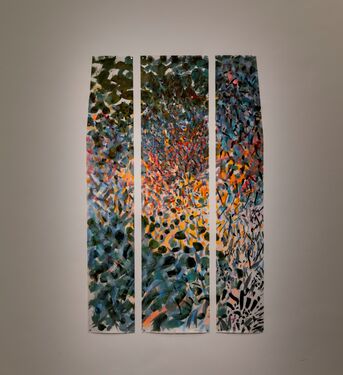
A Jerusalem Window
Samia Halaby, A Jerusalem Window, 2000. Painting, acrylic on polyester, 183 x 122 cm.
-
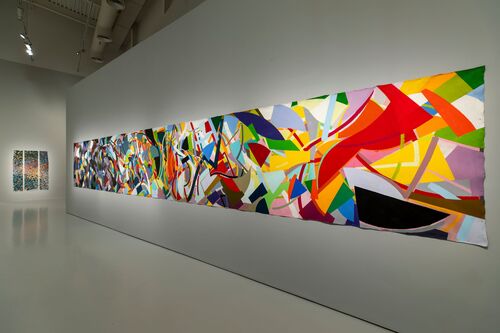
Transitions
Samia Halaby, Transitions, 1988-1989. Painting, acrylic on canvas, 132 x 891.5 cm.
-
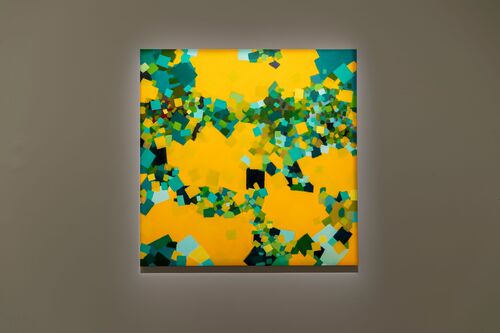
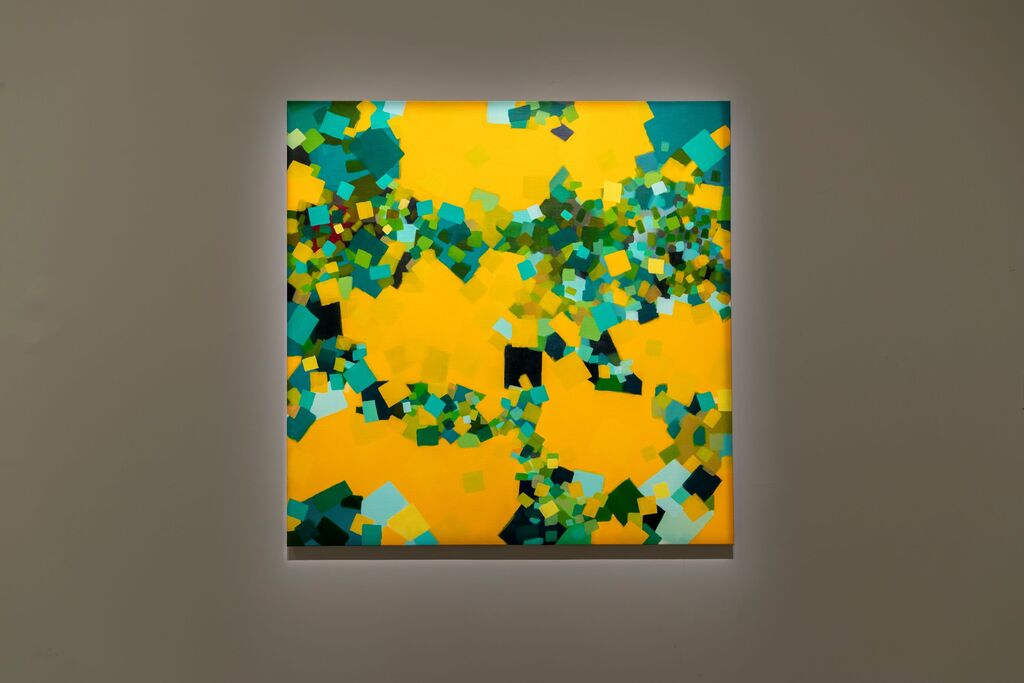
Six Golden Heroes
Samia Halaby, Six Golden Heroes, 2021. Painting, acrylic on canvas, 179 x 179 cm.
-
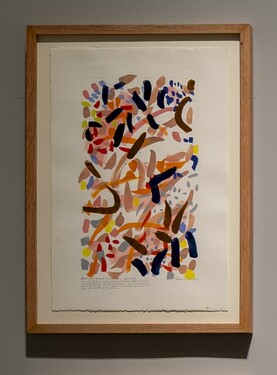
Occupied Jerusalem, It is...
Samia Halaby, Occupied Jerusalem, It is as Though…, , 1995. Drawing, watercolour on paper, 56.5 x 38 cm.